
One of the most revealing examples in Deutsche Telekom's AI strategy concerns customer authentication. In its October 2026 Investor Day presentation, the company illustrates a redesign that reduces 14 authentication methods to three common methods for adoption across nine countries. The instruction above the example is simple: "Simplify before automating."[11]
That example helps explain the company's approach. Giving employees AI tools can improve individual tasks. Changing how customers authenticate, how systems exchange information and who owns a customer journey requires management decisions across organisational boundaries.
Deutsche Telekom is pursuing both. Its published operating model has two delivery lanes: a smaller portfolio of major AI investments, and broader business-led adoption on common platforms.[11]
My reading of the case is that its most useful contribution is the connection between those lanes. Leadership concentrates resources on changes that matter to the business. Employees and operating units develop practical uses close to the work. Shared technology, business ownership and common controls make it possible to reuse what works.
The evidence also requires some restraint. These are largely company disclosures and executive accounts. They document a serious transformation effort, but they do not establish that every announced capability is fully deployed or that every projected saving has been realised.
1. The strategic direction came from the top
AI was already part of Deutsche Telekom's October 2024 Capital Markets Day strategy. The company linked it to customer-service improvement, network and data-centre automation, efficiency and a more data-driven business. AI sat alongside other operational and financial levers; the entire growth plan was never an AI-only forecast.[8]
By October 2026, the framing was more explicit. CEO Tim Höttges's presentation described AI as an "enterprise redesign," with business-owned adoption, reusable data products and a common design adapted to local systems.[12]
This matters because a telecom operator cannot redesign important workflows through voluntary tool adoption alone. A customer-service journey may cross billing, identity, network diagnostics and several operating companies. Someone must decide which variations are necessary, which can disappear, and who is accountable for the resulting service.
The company also set boundaries around where it would compete. Its CEO presentation ruled out building the next frontier large language model and competing with hyperscale data centres purely on scale. It instead emphasised trusted services, sovereignty, security and the use of partners' technology. That is compatible with investing in specialised sovereign AI infrastructure; it is not a withdrawal from infrastructure.[12]
Those boundaries are part of prioritisation. They protect resources for areas where the operator's customer relationships, network assets and business knowledge may provide an advantage.
2. The two delivery lanes explain how adoption works
The clearest account appears in From AI Adoption to AI Impact, presented by CHRO Birgit Bohle and Chief AI Officer Kartik Sheth at the 5 October 2026 Investor Day. The presentation describes a shared operating model, rather than proving that all business units have already implemented it uniformly.[10][11]
Lane one: a smaller number of major AI investments
Deutsche Telekom calls these "Big AI Bets." They are selected by value and complexity, with business ownership and a central portfolio view. Dedicated "Tiger Teams" force prioritisation and harmonise customer journeys. Four- or five-person AI-native squads build the products; forward-deployed engineers adapt them to operational environments. Business teams own adoption and return on investment.[11]
This is the top-down component in practical terms. Management selects the important problems and resolves the organisational decisions that a local team cannot settle alone.
The sequence is unusually clear:
- Quantify cash impact and complexity.
- Redesign the journey.
- Build a flexible product.
- Adapt it to local systems and support the change.
- Scale it under business ownership, improving performance over time.[11]
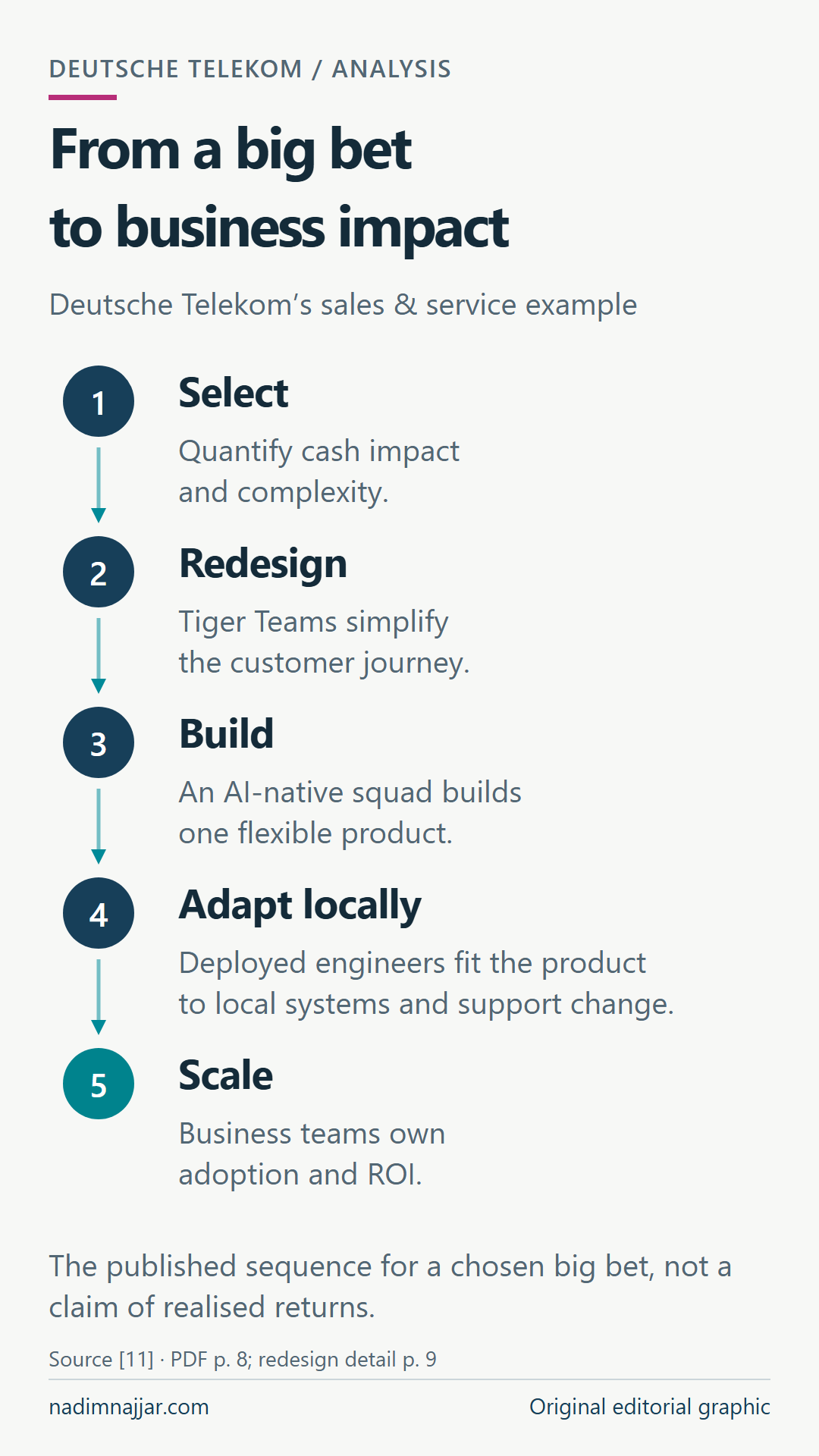
Original editorial rendering of the five-stage journey for a chosen Big AI Bet in Deutsche Telekom’s investor presentation, PDF page 8. Sales and service is the company’s example, not an independently audited outcome. Page 9 elaborates on simplifying the journey before automation.
Open full-resolution image · Source [11] · PDF p. 8; redesign detail p. 9
Read the diagram in words
- Select: Quantify cash impact and complexity.
- Redesign: Tiger Teams simplify the customer journey.
- Build: An AI-native squad builds one flexible product.
- Adapt locally: Deployed engineers fit the product to local systems and support change.
- Scale: Business teams own adoption and ROI.
The published sequence for a chosen big bet, not a claim of realised returns.
The authentication example belongs here. Its significance is the reduction of process variation before building automation. A company that automates every historical variation may preserve the very complexity it wanted AI to remove.
Lane two: business-led adoption on shared platforms
In the second lane, segments set local priorities. AI Builders receive central engineering support, configure approved tools and shared platforms, and work on skills and workflow redesign. The segments remain accountable for adoption and impact. Central teams help clear approvals and budget obstacles.[11]
This is more structured than an open invitation to experiment. Local teams have room to identify useful applications, but they do not need to build independent technology stacks or invent their own controls.
Employee access supports this approach. Deutsche Telekom launched AskT internally in 2024 and expanded it internationally in early 2025. Its annual report describes access to internal information and documents, alongside external model knowledge.[9] OpenAI's July 2026 case study describes employee experimentation with ChatGPT Enterprise happening alongside management-led redesign of customer-facing workflows.[3]
The October presentation also reports 22 AI-related communities with more than 6,000 members. That provides a concrete example of peer participation beyond centrally managed projects.[11]
The distinction is important: bottom-up adoption supplies practical knowledge and local demand; it does not remove business accountability.
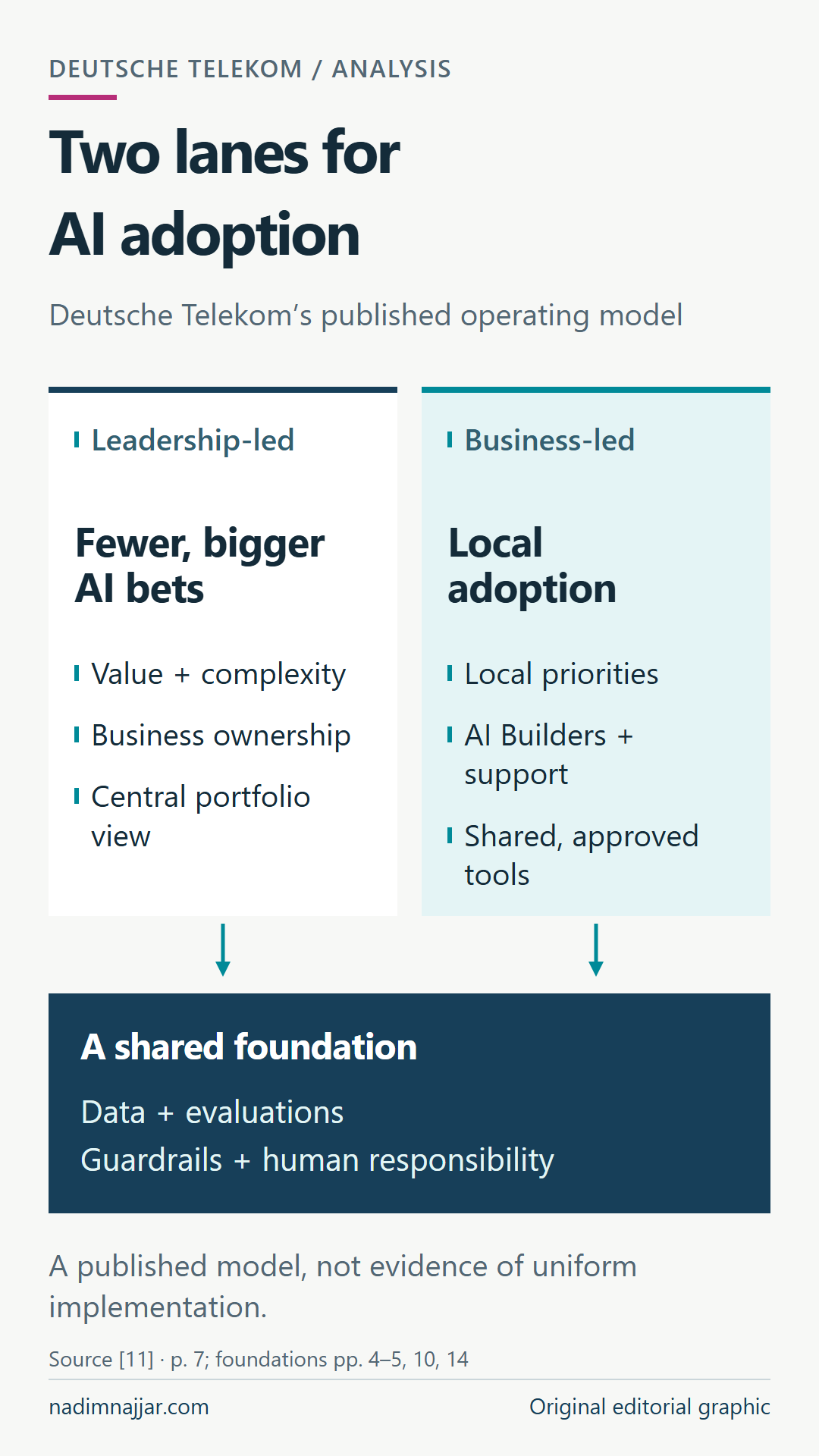
Original editorial synthesis of Deutsche Telekom’s published operating model. Leadership concentrates major investments while business units set local adoption priorities. Shared foundations connect the lanes; the disclosure does not establish uniform implementation.
Open full-resolution image · Source [11] · p. 7; foundations pp. 4–5, 10, 14
Read the diagram in words
- Leadership-led: Fewer, bigger AI bets; Value + complexity · Business ownership · Central portfolio view.
- Business-led: Local adoption; Local priorities · AI Builders + support · Shared, approved tools.
A shared foundation: Data + evaluations · Guardrails + human responsibility.
A published model, not evidence of uniform implementation.
3. How did they choose which use cases deserved attention?
The published selection rule for major investments is value and complexity. The next slide sharpens that to cash impact and complexity. The materials reviewed do not disclose a complete scoring formula, numerical weightings or an investment threshold. It would be misleading to invent one.[11]
The wider sources nevertheless reveal several consistent choices.
They sought repeated work with material operational impact. The October announcement identifies network operations, customer service, software development and administration as areas with large volumes of repetitive work.[7] High frequency gives even a modest improvement a chance to matter, provided quality holds.
They focused on complete workflows. The sales-and-service example starts with journey redesign and ends with business-owned adoption and ROI. It includes authentication and routing, rather than treating the conversational interface as the entire product.[11]
They looked for reuse across markets. Common design and local integration are explicit parts of the model. A solution that can serve several operating companies has a different investment case from a bespoke assistant that benefits one small team.[11][12]
They matched the technology to the task. In a June 2026 interview, Global Chief Architect Shekhar Kulkarni argued for selective use of agents in adaptive, decision-heavy workflows requiring multi-step reasoning. He distinguished these from billing and revenue-assurance processes that require determinism.[5]
That last point is particularly useful. An AI strategy does not require an agent to make every decision. An agent may help interpret an enquiry or coordinate a workflow while deterministic systems continue to calculate charges and execute controlled transactions.
My synthesis of the selection logic is: favour a business problem large enough to justify the effort, with a realistic integration path and a design that can be reused. Then use the least risky technology that can perform the task. The first part is directly reflected in the published model; the final formulation is a practical interpretation, not Deutsche Telekom's official scoring system.
4. What did they prioritise?
The evidence supports several investment areas, but not a public, exhaustive ranking from first to last.
Customer service and sales journeys
Customer care was an early area of investment, according to Jonathan Abrahamson, Chief Product & Digital Officer, in OpenAI's case study.[3] By October, the company was describing AI support for representatives during calls, automated documentation and Frag Magenta's handling of approximately 2.6 million customer-service calls in the first half of 2026.[7]
The attraction is understandable: frequent interactions, identifiable sources of customer frustration and outcomes that can be measured. Service also exposes the hard integration problems early. A useful assistant needs to understand the customer, retrieve the correct information and connect to systems that can resolve the issue.
The priority should therefore be understood as improving service journeys, with automation serving that outcome. A customer prevented from reaching a human has not necessarily had the problem solved.
Network operations and quality
Deutsche Telekom's 2025 annual report describes using large language models to create some network-disruption tickets since August 2024. The models extract and structure problem descriptions from incoming reports.[9]
Its October 2026 announcement reports that RAN Guardian detects impending network strain and supports countermeasures, with response time for those events falling from several hours to about one minute.[7]
These are different levels of application. Structuring a ticket is not equivalent to authorising a network change. The latter requires stronger validation, clear operating limits and a recovery path.
The company's 2030 ambitions refer to Level 4 autonomous networks for high-value use cases. They should not be read as a claim that its entire network already operates autonomously.[12]
Employee workflows and software delivery
AskT, ChatGPT Enterprise and Microsoft Copilot provide broadly accessible tools. The October presentation separately identifies developer tools and specialist applications, rather than assuming one general assistant fits every role.[11]
The strategic value of this work has two dimensions. Employees can improve the tasks they perform today. Developers and specialist teams may also accelerate the work needed to build and maintain the company's AI services.
The second benefit is an analytical inference, not a measured return disclosed in these sources. Code-generation activity alone cannot establish faster, safer software delivery. Testing, review effort, defects and maintainability still matter.
New customer services and enterprise revenue
The Magenta AI Call Assistant illustrates a product opportunity based on an existing customer habit: making a phone call. The March 2026 announcement described live translation, summaries and contextual assistance embedded in the network, with German availability planned to begin during the year.[6]
That announcement also specified opt-in activation and notification of call participants. Those design commitments matter because adding AI to a conversation changes the privacy expectations surrounding the service.[6]
On the enterprise side, the October announcement identifies sovereign AI infrastructure and business solutions as revenue opportunities. It sets an ambition of approximately €800 million in AI-related business-customer revenue outside the United States by 2030.[7]
This extends the strategy beyond internal efficiency. The operator is also trying to sell services built on its infrastructure and trusted access to customers. A product announcement or revenue ambition, however, is not evidence of universal availability or realised revenue.
5. Shared foundations connect the two lanes
The October presentation names five strategic postures: data as a differentiator, deep partnerships, an AI operating model, a flexible AI stack and "Human in the Lead." These describe how Deutsche Telekom intends to build and manage AI capability; they are not a ranked list of five use cases.[11]
Both delivery lanes sit on a shared AI foundation covering tools and models, a marketplace, observability, evaluations, compliance guardrails and token-cost optimisation. A separate people foundation covers capabilities, change management and roles.[11]
The company's Magenta AI-centric Reference Architecture, or MARA, addresses the same scaling problem at the architecture level. Kulkarni described its development in the second half of 2025 as a response to fragmented pilots and duplicated efforts.[5]
MARA distinguishes mandatory, preferred and exploratory components. It uses model and tool-access gateways, requires agent authentication and authorisation, and expects vendors to expose the logs and metrics needed to understand agent behaviour.[5]
This is an important answer to the tension between central control and local freedom. Standardising every application can make experimentation slow. Standardising access, identity, observation and policy enforcement can allow teams to experiment within known boundaries.
Data reuse is equally important. Group CIO Kanwardeep Singh Ahluwalia described a move towards reusable data products and a shared marketplace in a June 2026 interview.[4] The October operating-model presentation adds ownership, metadata, service expectations and semantic context to its data foundation.[11]
For telecom operators, that is a practical requirement. The meaning of a customer, service, network element or asset must remain consistent enough for an agent to act on it. A fluent response does not compensate for an incorrect relationship between those records.
6. Employee participation requires more than training
The company reports more than 100,000 employees trained in AI in its October announcement. Its accompanying presentation reports more than 250,000 AI "enablements" since 2023. Those are different measures; the latter should not be presented as a count of unique employees.[7][11]
The operating model assigns distinct responsibilities. AI Product Owners drive business value. Engineers build advanced solutions. Forward-deployed engineers adapt them within the business. AI Builders implement low-code or no-code applications. AI Leads drive process and workforce transformation. Employees are expected to assess outputs critically and provide feedback.[11]
This is a stronger basis for adoption than measuring course completion alone. Training provides familiarity; defined responsibilities help determine what happens when a useful prototype needs data access, operational support or approval to scale.
The workforce implications should not be softened into a claim that every job simply becomes easier. The same presentation discusses redesigning roles through tasks and activities, reskilling, building capabilities and reducing parts of the workforce mix. It does not quantify a job-loss outcome in these slides.[11]
Employee trust therefore depends on how management handles that transition. Human oversight is a responsibility that needs time, skills and authority, not a label added to an otherwise automated process.
7. What does the evidence actually prove?
The public material contains meaningful indicators, but they answer different questions.
- Adoption: OpenAI reported more than 50,000 monthly active users of ChatGPT and API tooling in July 2026. This demonstrates use of that toolset; it is not a measure of company-wide financial return.[3]
- Perceived productivity: The October presentation reports that 80% saw substantial productivity improvements and 65% reinvested saved time in work quality. Its footnote identifies a 2026 survey of 1,850 ChatGPT Enterprise users at Deutsche Telekom. These are self-reported survey results, not audited productivity gains across the workforce.[11]
- Operational activity: The company reported approximately 2.6 million Frag Magenta customer-service calls in the first half of 2026. That volume alone does not establish first-contact resolution, satisfaction or net savings.[7]
- Specific operational improvement: The reported reduction to about one minute concerns RAN Guardian's response to impending network strain. It is not a measure of all network incidents or outage restoration.[7]
- Financial ambition: Outside the United States, the company targets approximately €1.1 billion in gross savings from AI and automation by 2027 against a 2023 baseline, covering indirect costs and capital expenditure. Its €2.5 billion ambition for 2030 is an indirect-cost measure; the CEO slide includes capitalised labour in that measure. Both exclude token costs. These are different measurement bases, not a directly comparable series of net savings. Both remain targets and combine AI with automation.[7][12]
There is also an unresolved reporting inconsistency. The 2025 annual report states 53% regular employee AI use in November 2025; the October 2026 presentation shows 77% for that same month and 83% for May 2026. The sources reviewed do not reconcile the difference in definition or population. Those series should not be spliced into a single growth story.[9][11]
For management, the useful test is a combination of adoption, task quality, customer outcomes and financial performance. Ahluwalia explicitly rejected the number of proofs of concept or pilots as the measure of AI success, emphasising customer value, speed, efficiency and trust.[4]
8. What other telecom leaders can take from the case
The following is my proposed application of the case, rather than a claim about Deutsche Telekom's internal policy.
First, separate broad employee enablement from the portfolio of major operational changes. The two need different delivery methods and investment scrutiny.
Second, require a business owner before an important use case proceeds. That owner should define the baseline, the intended outcome, the acceptable error level and the process for handling exceptions.
Third, include process simplification in the project scope. If the workflow contains conflicting rules or unnecessary handoffs, funding only an AI interface leaves the difficult work untouched.
Fourth, evaluate complexity honestly. Data readiness, integration effort, local variation, risk and the cost of ongoing supervision all affect whether a promising demonstration becomes a useful service.
For asset lifecycle management, this could mean beginning with evidence-backed discrepancy triage: comparing records, identifying missing documentation and preparing a reconciliation proposal. Expansion into operational or financial changes should depend on data quality and approval controls. An agent finding a mismatch should not, by that fact alone, gain authority to change the asset register, initiate a write-off or alter network configuration.
Finally, measure the outcome after deployment. Useful measures might include verified resolution, fewer repeat contacts, reduced reconciliation effort, safer decisions and lower fully loaded cost. Tool usage belongs on that dashboard, but cannot substitute for those outcomes.
Conclusion
Deutsche Telekom's case offers a concrete answer to the top-down versus bottom-up debate. Its published model gives leadership responsibility for major investments and cross-market redesign, while business units and employees develop applications through shared platforms. Both remain tied to business ownership and common controls.[11]
The most instructive detail is still the authentication example. Before asking AI to handle the journey, the company examined how many versions of that journey it needed.
For telecom leaders, that is a useful starting point: choose the business outcome, simplify the work and establish who remains responsible. Employee experimentation can then inform a transformation that the organisation is equipped to deliver.
Source note: This analysis uses Deutsche Telekom investor presentations and disclosures, executive interviews and a vendor case study. Company-reported results are attributed; targets and analysis are distinguished from observed outcomes. References to PDF pages use file page numbers. The central two-lane model and authentication example appear on pages 7–9 of source 11; financial ambitions and exclusions appear on page 9 of source 12.
Sources
- How Deutsche Telekom is rewiring telecommunications with AI
- How DT’s group CIO measures AI success
- Why governance is key to Deutsche Telekom's new AI-centric architecture
- Deutsche Telekom reimagines phone calls with AI embedded in the network | Deutsche Telekom
- Deutsche Telekom boosts growth, efficiency and quality through the use of AI
- Deutsche Telekom plans to accelerate growth through the systematic use of artificial intelligence and global economies of scale | Deutsche Telekom
- Data & AI - Deutsche Telekom Annual Report 2025
- AI Investor Day | Deutsche Telekom
- From AI Adoption to AI Impact — Bohle and Sheth, AI Investor Day, 5 October 2026 (PDF)
- Company Strategy / AI Ambition — Tim Höttges, AI Investor Day, 5 October 2026 (PDF)